Example Article for Broadwater County Extension Agent
Weed of the Month: Pineappleweed
 | Author:
Allison Kosto, MSU Broadwater County Extension Agent
MSU Broadwater County Extension Agent |
Article Published: 07/24/2026 Volume: 5 Edition: 03Weed of the Month: Pineappleweed
Allison Kosto
MSU Broadwater County Extension Agent
A weed by a fun name, pineappleweed, isn’t a widespread problem, but it can be a nuisance in certain situations.
Description & Habitat
Native to northeastern Asian and the Pacific Northwest (but not Montana), pineappleweed has spread and naturalized across much of North America, including Montana. It is commonly found in lawns, distributed areas, poorly maintained sites, landscape beds and fields. It thrives in compacted soils and high traffic areas but does not like shade. While not a widespread issue, it can be problematic when conditions are right and is often growing where it is not wanted.
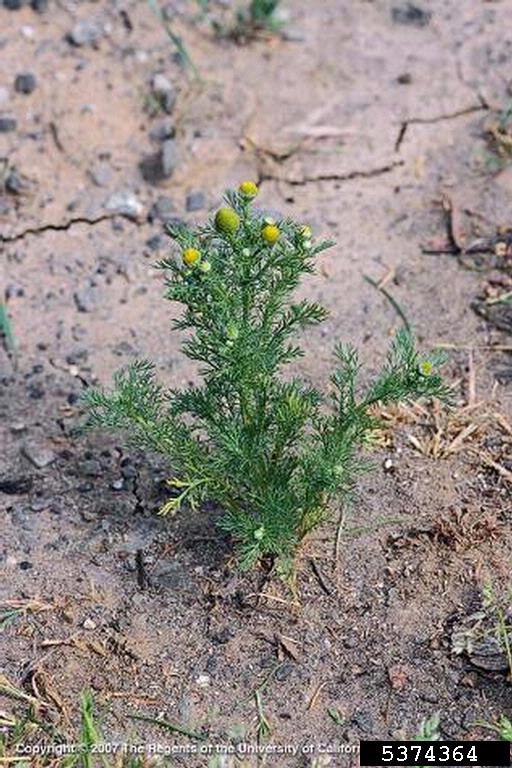
Pineappleweed is an annual plant (life cycle of one year) that germinates in the spring and grows through the summer. It can grow 6 to 12 inches tall but tends to be on the shorter side in Montana. It starts as a fern like rosette, then grows into a small plant. Leaves continue to maintain their fernlike appearance, and it looks like a small bush. It is sometimes confused with wild chamomile. It begins flowering in late spring and yellow flowers can be present throughout the summer. They are tiny, densely packed together to form a distinctive egg shape. Pineappleweed gets its name from its unique sweet, pineapple odor, especially when crushed. It reproduces by seed.
Maintaining a healthy and dense lawn or plant community will help reduce pineappleweed. Improving soil conditions, such as compaction where this plant thrives, can also help encourage desirable plants.
As an annual plant, controlling seed production is critical. Hand pulling, tilling and hoeing are effective before seed maturation. Mowing is generally not effective because it can regrow below the height of the mower blade and still reproduce. Mulching is an effective control method where practical. Landscape fabric or organic mulch at least 3 inches thick is necessary.
Herbicides can be effective. Preemergent herbicides are a good option in lawns and perennial landscape areas. Commonly used post-emergent chemicals include Banvel, Trimec, Roundup, and Weedmaster. Always read and follow the entire label when applying herbicide. Common chemical names are used for clarity but do not imply endorsement of a product or brand.
For assistance on weed identification and management, contact the MSU Extension Office in Broadwater County at 406-266-9242.
Article Images
Click on Image Thumbnail(s) to view fullsize image
PhotoCredit: Joseph M. DiTomaso, University of California - Davis, Bugwood.org
Image 1 Caption: Pineappleweed
Photo Credit: Joseph M. DiTomaso, University of California - Davis, Bugwood.org