Example Article for Broadwater County Extension Agent
Weed of the Month: Bull Thistle
 | Author:
Allison Kosto, MSU Broadwater County Extension Agent
MSU Broadwater County Extension Agent |
Article Published: 06/26/2026 Volume: 4 Edition: 51Allison Kosto
MSU Broadwater County Extension Agent
While many plants have “thistle” in their name, they must meet certain qualifications to be a true thistle. True thistles are in the sunflower family and have spiny leaves and bracts, which are the area underneath the flowers. Montana has five exotic and ten native thistles. Only one of which is a noxious weed, Canada thistle. Musk thistle, a county-listed noxious weed, is also very common and has been covered in the past. This month, we’ll be talking about bull thistle, which is also a common exotic thistle in Broadwater County.
Description & Habitat
Native to Europe, western Asia and North America, bull thistle likely arrived to North America during colonial times as seed contamination or in a ship's ballast. It is now widespread across the United States, including Montana. It is established in a variety of habitats but prefers disturbed areas or bare soil. It does not grow well in shade.
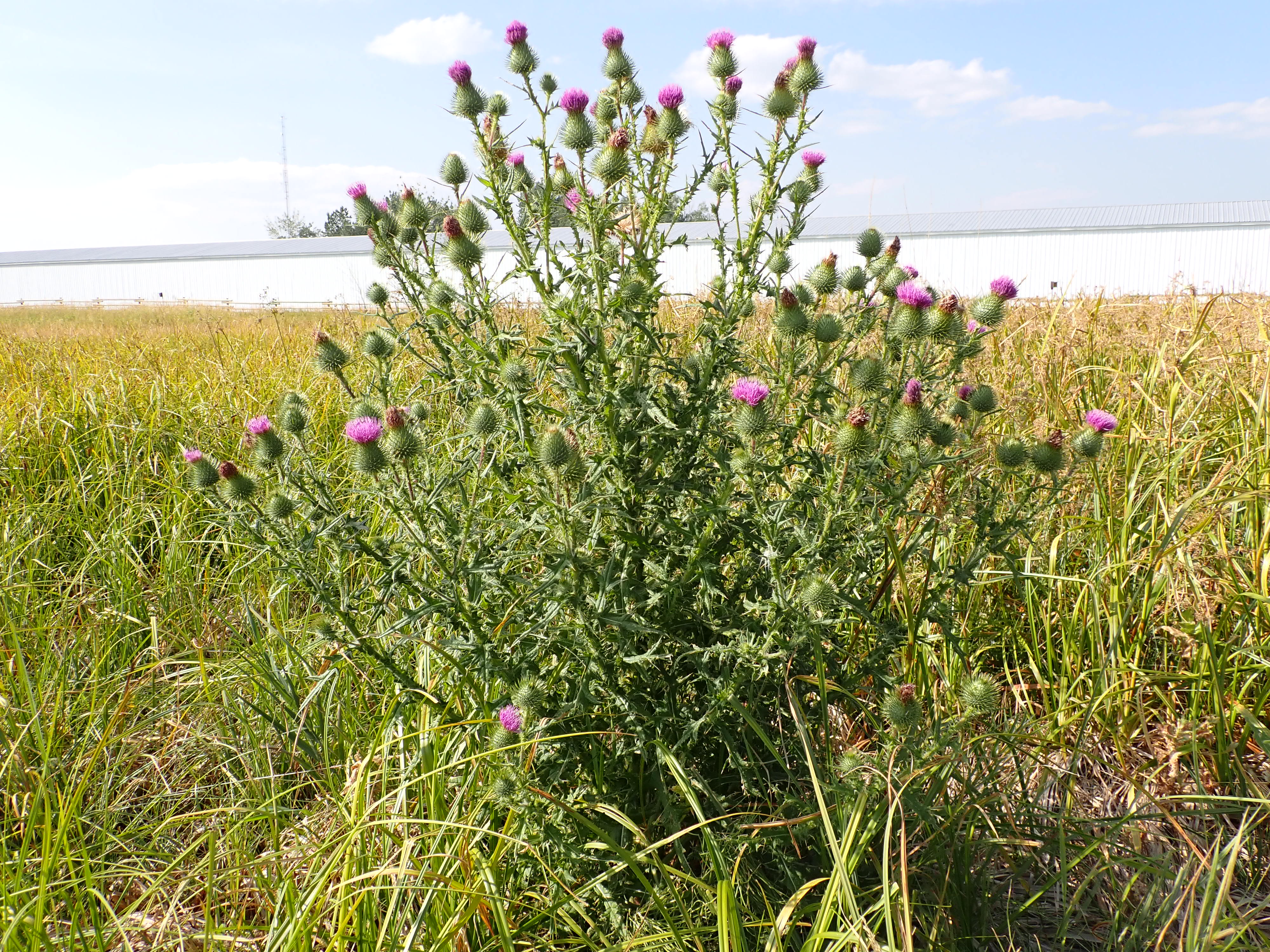
Bull thistle is a biennial plant, which means it has a life cycle of two years. The first year it has a spiny rosette with a taproot up to 28 inches long. The second year, it grows 1 to 5 feet tall. It is one of the spiniest thistles. The spines are on the surface of the leaves in addition to the leaf margins. One of the unique characteristics of this plant is that it tends to develop spiny wings where the leaves continue down the stem beyond the point of attachment to look like wings. Flowers are purple, on rare occasions, white. Bull thistle reproduces only by seed. A single plant can produce up to 4,000 seeds.
Like many other exotic thistles, bull thistles can spread quickly, especially with disturbance. Bull thistle can create a dense thicket. Their spines make it difficult for livestock to graze in and around the plants, as well as limit recreational activities. The presence of thistle in hay decreases forage and market value.
Management
Human activity is the primary spreader of seeds. Do not drive or walk in areas that are heavily infested if possible. Research has shown that seeds can travel over 160 miles on a vehicle in dry conditions. Wash vehicles, ATVs and any equipment before going home. The plant is dependent on bare ground or disturbance to establish, so maintaining competitive vegetation is key to preventing establishment.
Since bull thistle only reproduces by seed, one key management goal is to prevent it from producing flowers and setting seed. The plant can be killed by cutting the root below the soil surface. Cut flowerheads and dispose of them to prevent dispersing seeds. Tillage and mowing are also effective. There are currently no biological agents in Montana available to control bull thistle.
Selective herbicides can provide good control. The best time to spray is the first year or in the spring when the plant is in the rosette stage. Commonly used chemicals include 2,4-D, Banvel, Milestone, Telar, Transline and Perspective. Always read and follow the entire label when applying herbicide. Common chemical names are used for clarity, but do not imply endorsement of a product or brand.
For assistance on weed identification and control, contact the MSU Extension Office in Broadwater County at 406-266-9242 or the Broadwater County Weed District at 406-266-9243.
Article Images
Click on Image Thumbnail(s) to view fullsize image
PhotoCredit: Matt Lavin
Image 1 Caption: Bull Thistle
Photo Credit: Matt Lavin