Example Article for Broadwater County Extension Agent
Weed of the Month: Field Bindweed
 | Author:
Allison Kosto, MSU Broadwater County Extension Agent
MSU Broadwater County Extension Agent |
Article Published: 05/01/2026 Volume: 4 Edition: 43Weed of the Month: Field Bindweed
Allison Kosto
MSU Broadwater County Extension Agent
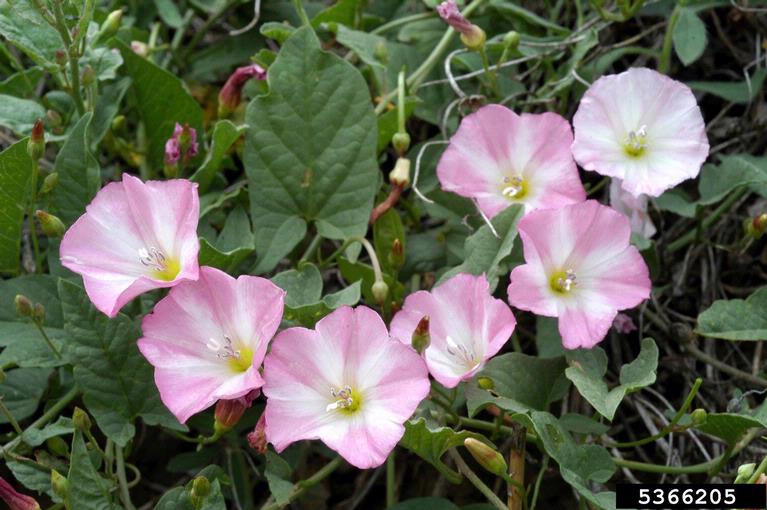
At first glance, this weed might look like a pretty morning glory flower. However, when you look closely, you may discover Field Bindweed which is a Montana Noxious Weed. It’s widespread throughout the state and difficult to control. In my opinion, it is one of the worst on the noxious weed list.
Description & Habitat
Like many noxious weeds, Field Bindweed is native to Eurasia. It was first introduced to the United States in Virginia in 1739 as a contaminant in crop seed. Even before 1900, people began to recognize this plant was a menace. By this time, bindweed was established in all western states. It can be a serious problem in fields, lawns, gardens and along roadsides.
A member of the morning glory family, field bindweed is a vine that grows along the ground until it reaches something to climb. It prefers strong sunlight and will grow towards the sun. It climbs rapidly and forms a dense mat, often choking out or shading desirable forage. The root system of this plant is also very impressive and is what makes it hard to control. Roots grow both vertically and laterally, creating a dense mat under the soil. The plant primarily reproduces by its root system and it can expand by 6 to 10 feet wide each year. Flowers are white to pink. They are funnel or bell-shaped, just like a standard morning glory.
Crop yields can be reduced by 50% or more in dense infestations. Bindweed can also clog machinery or become entangled during tilling or harvest. It is mildly toxic to livestock, especially horses and pigs, and can cause digestive disturbances.
Management
You can play a role in reducing the spread of seeds. Check the label of wildflower seed mixes to make sure it does not contain any noxious weeds before you plant. Do not drive or walk in heavily infested areas if possible. Wash vehicles, ATVs and equipment before going home. Do not use compost or top soil with plant parts from field bindweed unless it has been thoroughly composted (at least 180 degrees for 7 days) or sterilized, because new plants can start from root fragments.
Hand pulling and mowing is not effective due to the extensive root system. Tillage is effective if done consistently for 3 to 5 years. Sheep will graze bindweed and temporarily suppress it. However, once the sheep are removed, it will usually fully recover due to the root system.
Two biological control agents have been released in the United States, but there is limited availability in Montana. This is not a valid option at this time.
The use of herbicide is currently our most useful tool for established patches. However, effectiveness is not always good and repeated applications may be needed. The most effective herbicide is Tordon, but it is restricted use and not an option for everyone. Other options include Roundup (nonselective), 2,4-D, Banvel, Escort and Weedmaster. The best time to spray is from budding to full bloom. Always read and follow the entire label when applying herbicides. Common chemical names are used for clarity, but does not imply endorsement of a product or brand.
For assistance on weed identification and control, contact the MSU Extension Office in Broadwater County at 406-266-9242 or the Broadwater County Weed District at 406-266-9243.
Article Images
Click on Image Thumbnail(s) to view fullsize image
Image 1 Caption: Field Bindweed.
Photo Credit: K. George Beck and James Sebastian, Colorado State University, Bugwood.org