Example Article for Broadwater County Extension Agent
We’re in Drought AGAIN
 | Author:
Allison Kosto, MSU Broadwater County Extension Agent
MSU Broadwater County Extension Agent |
We’re in Drought AGAIN
Allison Kosto
MSU Broadwater County Extension Agent
To no one’s surprise, after a mild winter, we are in yet another drought. If it seems like we have drought conditions a lot, it’s true. An MSU Extension Specialist likes to remind us that we have less than “normal” precipitation 50 percent of the time. Drought is one of the more likely and common natural hazards. However, what truly defines a drought and the severity of the drought is actually more complicated.
The National Drought Mitigation Center defines drought as “a deficiency of precipitation over an extended period of time (usually a season or more), resulting in a water shortage.” The US Drought Monitor takes this a step further to define both short- and long-term drought. A short-term drought typically lasts less than 6 months with a focus on precipitation within the last 1 to 3 months. In a short-term drought, there can be impacts to agriculture and grasslands, but the drought classification can fluctuate quickly with precipitation changes.
On the other hand, a long-term drought is longer than 6 months and considers precipitation up to 60 months. In a long-term drought, deeper impacts on hydrology and ecology can be seen, such as complete crop and forage failure, livestock sell-offs, native plant dieback, increase in invasive plant species, increased wildfire risk and shortage of drinking water. It’s important to note that in a long-term drought even short-term gains in precipitation may not affect the deep impacts of the drought unless those changes can sustain for a longer duration.
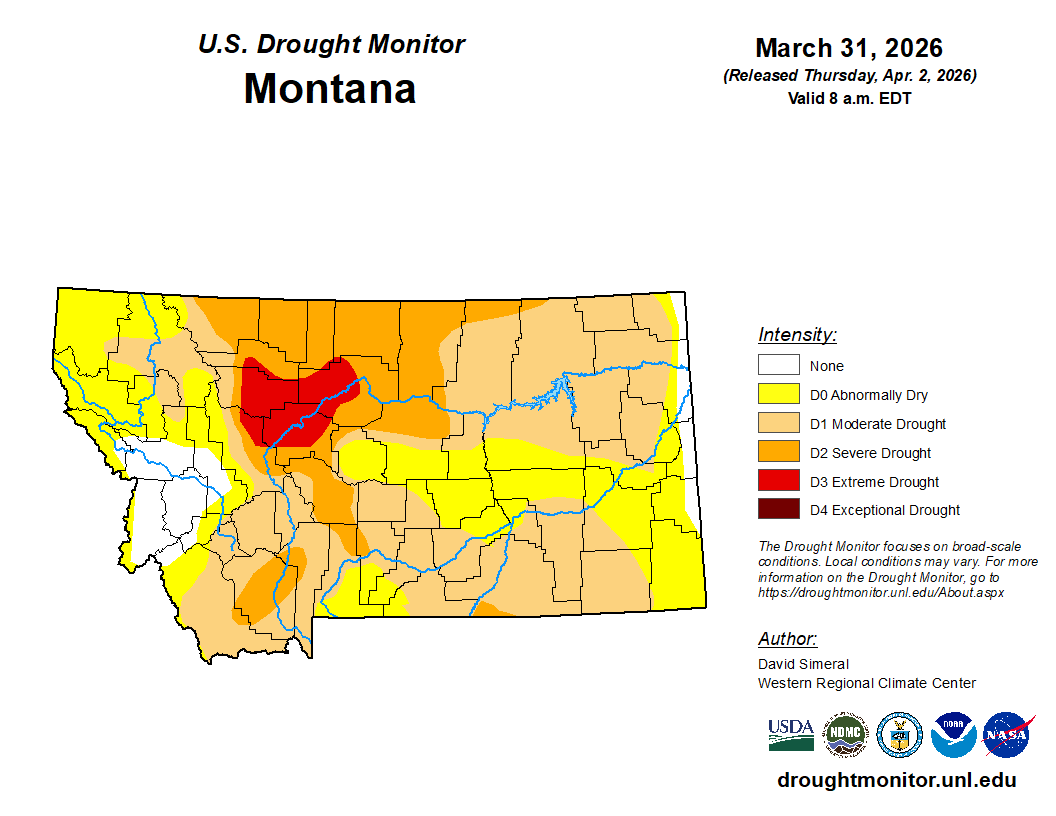
The US Drought Monitor classifies droughts into five different drought categories starting at D0, which is abnormally dry to D4, which is exceptional drought. At the time this article was written, Broadwater County was rated D1 for moderately dry. Most of the state is in drought with the worst in the Golden Triangle area which is D3 for extreme drought. To determine these drought categories, the Drought Monitor uses precipitation and climate data, local observations and expert judgement.
Through looking back through history, researchers can study the long-term effects of drought and how it changes the landscape and even cultures over time. Modern data only dates back 100 to 150 years but through looking at tree rings, sediments, ice cores and artifacts, scientists can begin to understand changes over time. An example in North America was a long-lasting drought during the 13th century that was thought to result in the decline in the Ancestral Puebloans in the Southwest. In more recent history, the Dust Bowl of the 1930’s lasted nearly a decade and affected 80 percent of the United States. It resulted in major losses in crop production, an increase in poverty and a mass migration from agriculture to the population centers for other types of work. In the late 1980s, the United States experienced one of the costliest droughts in history, resulting in approximately $39 billion loss in agricultural crops, energy, water and ecosystem impacts.
Short-term droughts can be caused by changes in regular weather patterns. For example, La Nina is when surface water in the Pacific Ocean decreases in temperature. These cooler waters affect storm patterns resulting in drier-than-normal conditions in North America. La Niña weather patterns typically last about a year. Both the Dust Bowl and the 1988 Drought were caused by La Nina effects.
There is more debate about the association between drought and climate change. A study done by NASA predicted fluctuations in both rainfall and drought with some areas of the world receiving higher rainfall and increased flooding, while other areas will experience increased drought. Other scientists believe that global warming will create a warmer and wetter climate overall.
Even though drought is a common and natural part of our world, it doesn’t make it easier. Those in the agricultural industry are most affected by this phenomenon. Most agricultural operations are able to withstand some level of drought through climate resiliency practices such as crop rotation, rest rotation grazing, lowering stocking rates, hay stockpiling and improving soil health. The challenge becomes when the drought is prolonged or comes at a bad time. For example, a short-term drought in the late winter and spring can be more devastating than a fall or early winter drought.
During a drought, assistance can sometimes be available to help agricultural producers. However, in order for this to happen, the governor has to declare a state of emergency or certain thresholds have to be met. Contact and register with the local Farm Service Agency (FSA) to be eligible for these programs when they become available.
For further questions, contact the MSU Extension Office in Broadwater County at 406-266-9242 or allison.kosto@montana.edu.
Article Images
Click on Image Thumbnail(s) to view fullsize image
PhotoCredit: David Simeral, Western Regional Climate Center
Image 1 Caption: Drought Monitor Map
David Simeral, Western Regional Climate Center