Example Article for Broadwater County Extension Agent
Weed of the Month: Catchweed Bedstraw
 | Author:
Allison Kosto, MSU Broadwater County Extension Agent
MSU Broadwater County Extension Agent |
Weed of the Month: Catchweed Bedstraw
Allison Kosto
MSU Broadwater County Extension Agent
A problem in certain situations, catchweed bedstraw gets its name for two reasons. It’s called catchweed because the stems have stiff hairs that “catch” on clothing or fur that comes tangled in it. Bedstraw is recognition to its historical use as mattress stuffing. It’s also an edible and medicinal plant whose leaves can be eaten raw or cooked. The fruits can be roasted and used as a coffee substitute. Another name for catchweed bedstraw is stickywilly.
Description & Habitat:
There is much debate on whether catchweed is native to North America. It is widespread across North America in a manner that suggests it is native. Others claim that it arrived in the fur of animals through the Bering Strait. The reality is that both are likely and it may be a combination that has led to its widespread nature across the continent.
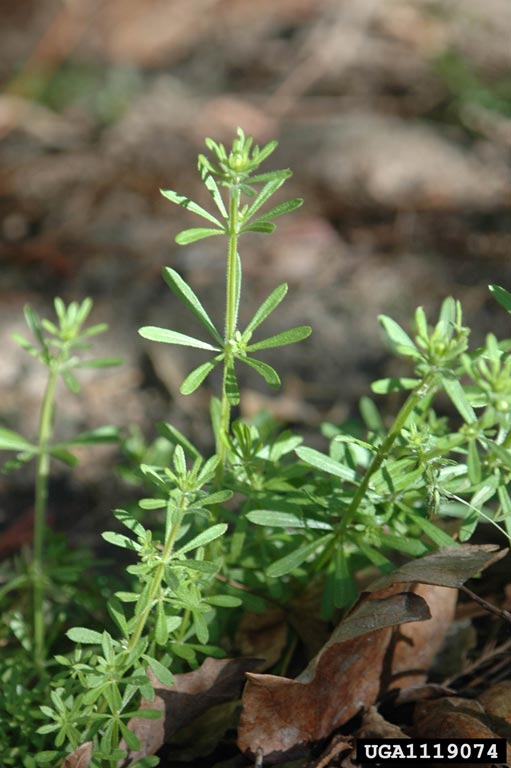
Catchweed has square stems with backward turning bristles that allow the plant to cling to other plants, objects, clothing and fur. The stems can grow long but are not strong, so they will fall over to form a mat if they don’t have anything to climb. Leaves are long and narrow, gathered in a whorl shape around each stem node. Flowers are very small with four white petals. Seedpods are tiny and brown and also have hook-like hairs that stick to nearly anything. It is a cool season plant that grows in the spring and may have another flush of growth in the fall. It is an annual plant (life cycle of one year) that only reproduces by seed. A mature plant can make more than 300 seeds.
While not a widespread issue across Montana, it can be problematic when conditions are right. It prefers shade to partial shade and moist soil. It is often found along the edge of woody areas and in landscape beds. It often grows close to the ground but can climb up and over other plants. It can form a mat across the ground that can cause people and animals to trip or stumble on the dense, sticky vegetation.
Management
Maintaining a healthy and dense lawn or plant community will help reduce catchweed. Seeds only stay viable in the soil for two years, so controlling seed production is critical with this plant. When it’s young, the whole plant is easy to pull from the ground. Gloves are necessary. As it matures, the root system becomes strong with a week attachment at the base. It will likely break off at this point and can regrow from the roots. Tilling and hoeing can also be successful on young plants. Mulching is an effective control method where practical. Landscape fabric or organic mulch at least 3 inches thick is necessary.
Herbicides can be effective. Preemergent herbicides are a good option in lawns and perennial landscape areas. Commonly used post-emergent chemicals include Banvel, Trimec, Goal2XL and Roundup. Always read and follow the entire label when applying herbicide. Common chemical names are used for clarity but do not imply endorsement of a product or brand.
For assistance on weed identification and management, contact the MSU Extension Office in Broadwater County at 406-266-9242.
Article Images
Click on Image Thumbnail(s) to view fullsize image
PhotoCredit: Chris Evans, University of Illinois, Bugwood.org
Image 1 Caption: Catchweed Bedstraw
Chris Evans, University of Illinois, Bugwood.org