Example Article for Broadwater County Extension Agent
Weed of the Month: Stinkgrass
 | Author:
Allison Kosto, MSU Broadwater County Extension Agent
MSU Broadwater County Extension Agent |
Allison Kosto
MSU Broadwater County Extension Agent
A rather unique and interesting grass species, stinkgrass, has been increasing in the county in recent years. It is likely increasing due to changing climates and a longer growing season.
Native to Eurasia, stinkgrass was accidently introduced to the United States in the early 1800s and is now widespread across North America. It does well in a variety of soil types and can be found along roadsides, pastures and lawns. It’s not highly competitive so it tends to be in places that are disturbed or lack healthy vegetation.
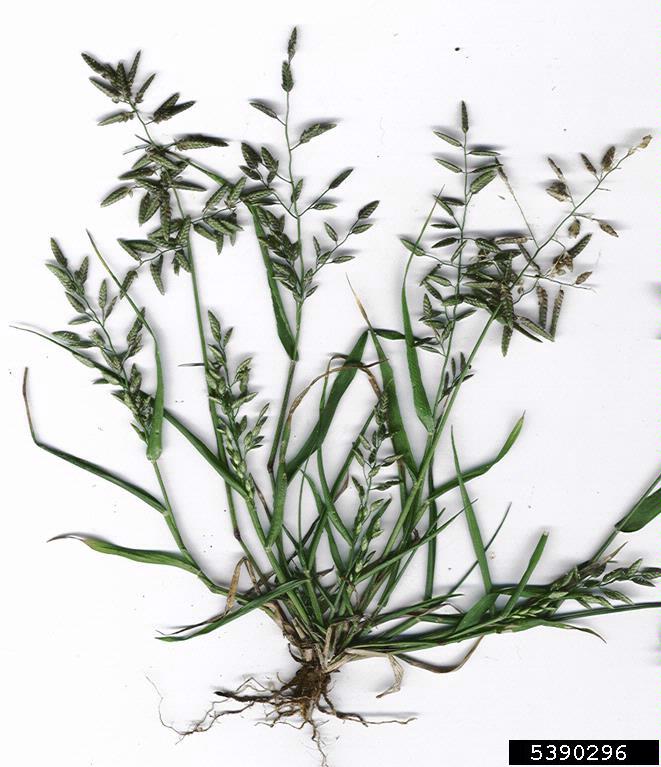
Stinkgrass is a warm season annual grass (life cycle of one year). As a result, you more commonly see it during mid-to-late summer. It’s fairly easy to identify due to its grayish-green, triangular shaped seed head. It resembles seedheads of those in the bluegrass family but stinkgrass often has a much larger seedhead. However, the most distinctive characteristic about stinkgrass is its unpleasant odor. It can grow 6 to 24 inches tall but is more often on the shorter side in Montana.
Stinkgrass is poisonous to livestock, especially horses. However, due to the smell they are unlikely to eat it. Additionally, poisoning typically occurs with repeated consumption over an extended period of time. Typically, the quantity found in our area isn’t enough to warrant concern. Further south, where warm season grasses are more common, it is more of a concern.
Management
The key to preventing establishment of stinkgrass is to maintain healthy vegetation. It’s not extremely competitive so it will disappear or be a minimal issue if you have a healthy lawn, pasture or rangeland. In lawns, proper management of fertility, mowing and irrigation will eventually crowd it out. Stinkgrass also kills easily with the first frost which gives additional opportunity for cool season grasses to fill in.
Stinkgrass is also sometimes found on the edges of driveways, lawns or areas that are difficult to maintain healthy vegetation. In these areas, control may be warranted. It can be easy to remove by hand pulling or digging. Glyphosate products such as Roundup are the most common herbicides in these areas. Finale is another option. Pre-emergent herbicides can also be used but are rarely needed in Montana. Always read and follow the entire label when applying herbicide. Common chemical names are used for clarity but does not imply endorsement of a product or brand.
If you need help with plant identification, pest management options or lawn care, contact the MSU Extension Office in Broadwater County at 406-266-9242 or allison.kosto@montana.edu.
Article Images
Click on Image Thumbnail(s) to view fullsize image
PhotoCredit: Forest and Kim Starr, Starr Environmental, Bugwood.org
Image 1 Caption: Stinkgrass
Credit: Forest and Kim Starr, Starr Environmental, Bugwood.org