Invasive of the Month: Eastern Heath Snail
 | Author:
Allison Kosto, MSU Broadwater County Extension Agent
MSU Broadwater County Extension Agent |
Article Published: 09/25/2026 Volume: 5 Edition: 12Allison Kosto
MSU Broadwater County Extension Agent
You might have noticed a slight change to my usual monthly title. Instead of a weed this month, I’m sharing information on a different type of invasive species, the Eastern Heath Snail. Weeds often get the limelight when it comes to invasive species. However, there are many other invasives that we need to watch for, including the bullfrog, emerald ash borer, feral swine, zebra mussels, and Japanese beetle.
Description & Habitat:
Native to central Europe and the Mediterranean, the Eastern Health Snail has only been found in three areas of North America. This includes Detroit, Michigan, south Ontario, and central Montana. It is not known how the snail arrived in Montana. They are genetically different than the snails in Michigan and Ontario, which means they were not from those sources. One theory is that they may have arrived in the early 1900s on mining equipment, as they were first discovered in Belt. They were formally identified as an invasive species in Montana in 2012. They have since spread to Cascade, Chouteau, Judith Basin, and Fergus Counties. They were recently discovered in Gallatin County, which makes them one step closer to Broadwater.
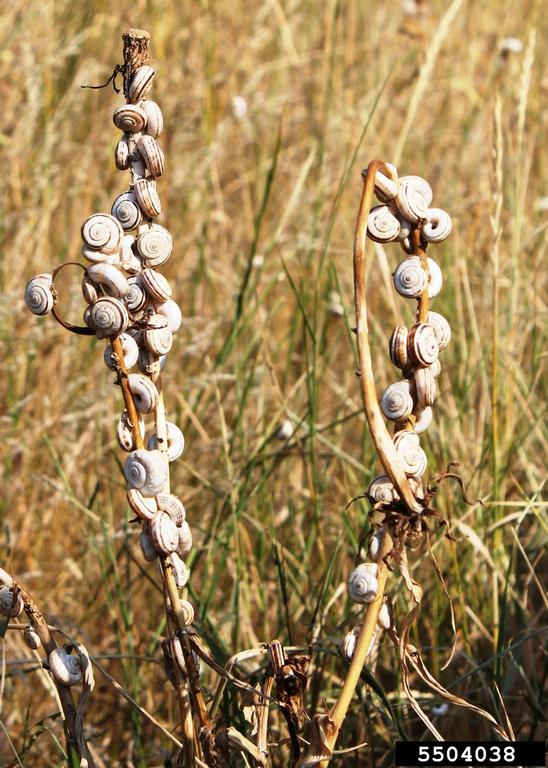
The Eastern Heath Snail. Health Snail is a little smaller than a dime in diameter. It is white, often with spiral brown bands. There are native snails that look similar. However, one of the distinguishing features is the behavior of the Eastern Heath Snail. They are known for climbing objects such as vegetation, fence posts, and other high objects during hot temperatures. The snails prefer dry, open, grassy areas including roadsides, rangeland, and crops. Habitat suitability modeling done by the Montana Natural Heritage Program found areas within Broadwater County that have low but viable potential habitat for the snails. The snails are self-fertile, which means a single snail can populate an entire area.
The snails are detrimental for a few reasons. They feed on plants. They are particularly fond of peas, lentils, and chickpeas, which are important crops in areas of Montana. In addition to crop damage, the snail bodies contaminate the crop and are costly to clean. Crushed snails also gum up harvest equipment and swathers. When the snail body’s dry, it’s hard and difficult to clean. The Eastern Heath Snail is also a vector to several diseases, including sheep lungworms. A study done by the Montana Bureau of Business and Economic Research determined the potential impact of the Eastern Heath Snail to Montana agriculture at $1.4 million per year for mitigation and post-harvest processing costs.
Management:
Early detection is key to keeping the Eastern Heath Snail from spreading further. Because the snail does not move quickly, humans are the primary vector of translocating the pest to other locations. If you live or work in a county where the snail is found, carefully check materials or equipment before moving. If you find any, they should be removed and crushed. Never move soil or gravel from infested areas because it can harbor snails or eggs.
If you have the snail, there aren’t a lot of options other than making the environment less hospitable to reduce the number of pests. Remove trash, litter and plant material that can provide hiding places. Mowing vegetation helps reduce options for snails to climb and congregate. Modifying sites by raking, harrowing, grading, rolling or resurfacing helps ensure shells are crushed and also reduces habitat. Burning is also an effective method of control where practical.
Snail bait or molluscicides are available but are typically not practical at the large scale. They can be useful around homes or gardens to exclude snails. Always read and follow the entire label when applying pesticides.
Snails are easily overlooked. If you see any suspicious snails, contact the MSU Extension Office in Broadwater County at 406-266-9242 for verification.
Article Images
Click on Image Thumbnail(s) to view fullsize image
PhotoCredit: Ian Foley, Montana Department of Agriculture, Bugwood.org
Image 1 Caption: Eastern Heath Snails
Ian Foley, Montana Department of Agriculture, Bugwood.org