MSU Study Links The West’s Extreme Snow Drought To Climate Change
Author: Ellis Juhlin, Mountain Journal
Article Published: // Volume: Edition: Bare ground flanked the edges of ski runs. It rained in December. Flower beds never went dormant. Snow plows sat gathering rust. As these conditions took hold across Greater Yellowstone and the West last winter, Marianne Cowherd, a snow scientist at Montana State University, was hit with question after question.
“People around me would ask if the snow was so bad because of climate change, and I would find myself having to answer, ‘Probably?’” Cowherd said. “But I don’t really know for sure. And I said that a lot of times over the course of the winter.”
She wasn’t alone. Researchers in Colorado and Wyoming faced similar queries. So they teamed up to find answers. “By the time March and April rolled around, we decided that really we should try to do the formal steps that you need to take to understand whether or not it was caused or attributable to climate change,” Cowherd said.
They found that, yes, human-caused climate change is to blame for this year’s snow drought. According to their research, recently published in the journal Proceedings of the National Academy of Sciences, a lack of snow this severe across the West is more than 4 times more likely to occur because of human-caused warming.
The burning of fossil fuels, like coal or oil, for power releases greenhouse gases that trap heat and cause the Earth to warm. There are many types of planet-warming emissions, the main contributors to warming are carbon dioxide and methane. Scientists have monitored atmospheric carbon dioxide since 1958, and it has increased every year since.
This warming increases drought events, decreasing annual snowfall and prompting spring runoff earlier each year. Higher temperatures and lower precipitation also elongates the wildfire season and a warmer climate drives more intense, large-scale fires on the landscape. In ecosystems like Greater Yellowstone, warming impacts wildlife like wolverines dependent on robust snowpacks to build dens, or the timing of the spring green-up that ungulates such as elk and pronghorn rely on to sustain migration. Climate change also disrupts agriculture and harms human health with extreme heat, and increases natural disasters.
“It’s not something that we would expect to happen in the way that it did if there were no climate change occurring,” Cowherd added.
That likelihood is even higher in areas that were especially hard hit, like the Upper Colorado River Basin, where climate change made this winter’s extreme snow drought 14 times more likely.
The research stemmed from a high-resolution dataset compiled by the U.S. National Science Foundation’s National Center for Atmospheric Research supercomputer, housed at the University of Wyoming. that track how watersheds change across a landscape, going all the way back to 1850. Cowherd and her co-authors were able to compare this winter to winters before the Industrial Revolution, when humanity’s large-scale planet-warming emissions hadn’t yet begun.
“We’re not just looking at the average temperature for this year and saying, OK, it was really warm, therefore this is a climate-attributed drought,” Cowherd explained. “We’re actually building a good guess of what the world would have been like if there were no climate change, and that’s how we do the actual attribution.”
The researchers’ models predict that in the current climate, snow drought would occur every 6.8 years, compared to just once every 30 years during preindustrial times. Cowherd says it’s important to understand events like this snow drought, because of how vital snow is for replenishing water resources in the mostly arid Mountain West. She hopes land managers can use findings like these to proactively plan for the warming that has already occurred. But she also sees a thread of hope in the research.
“This is a negative impact of anthropogenic climate change, and that is difficult to hear, difficult to learn, but it also means that it’s within our control to a certain degree,” she said. “If we pursue these lower emission scenarios … we would expect years like this to happen less frequently.”
Article Images
Click on Image Thumbnail(s) to view fullsize image
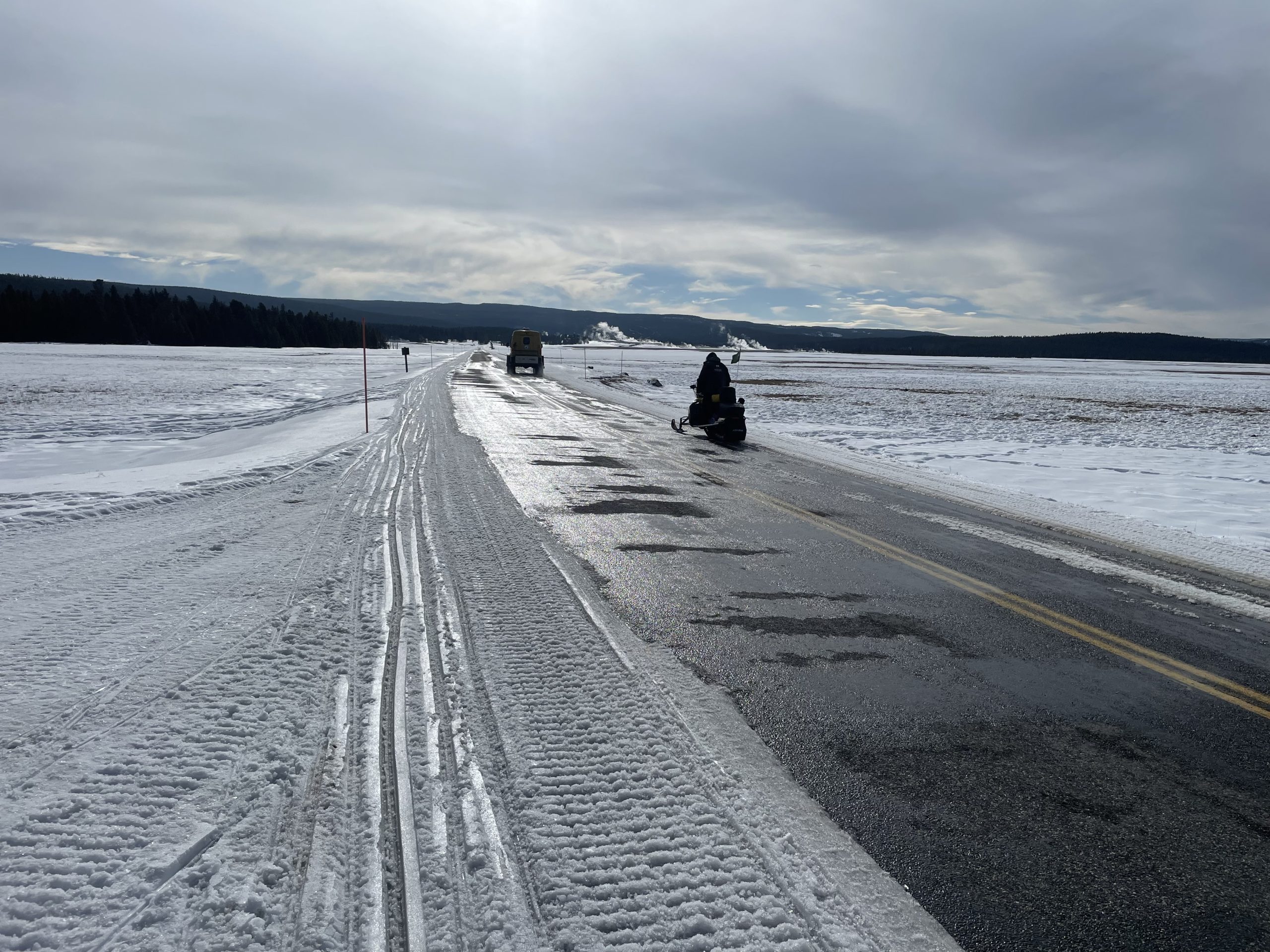
Image 1 Caption: Snowmobilers and a snow coach in Yellowstone National Park contended this past winter with warm days and dry patches of road. This photo was taken on Feb. 7 2026. Credit: Mark DeGraff

_50.png)



