Guest Editorial: Proposed I-47 Interstate
Author: JB Howick, Townsend City Council, Ward 1
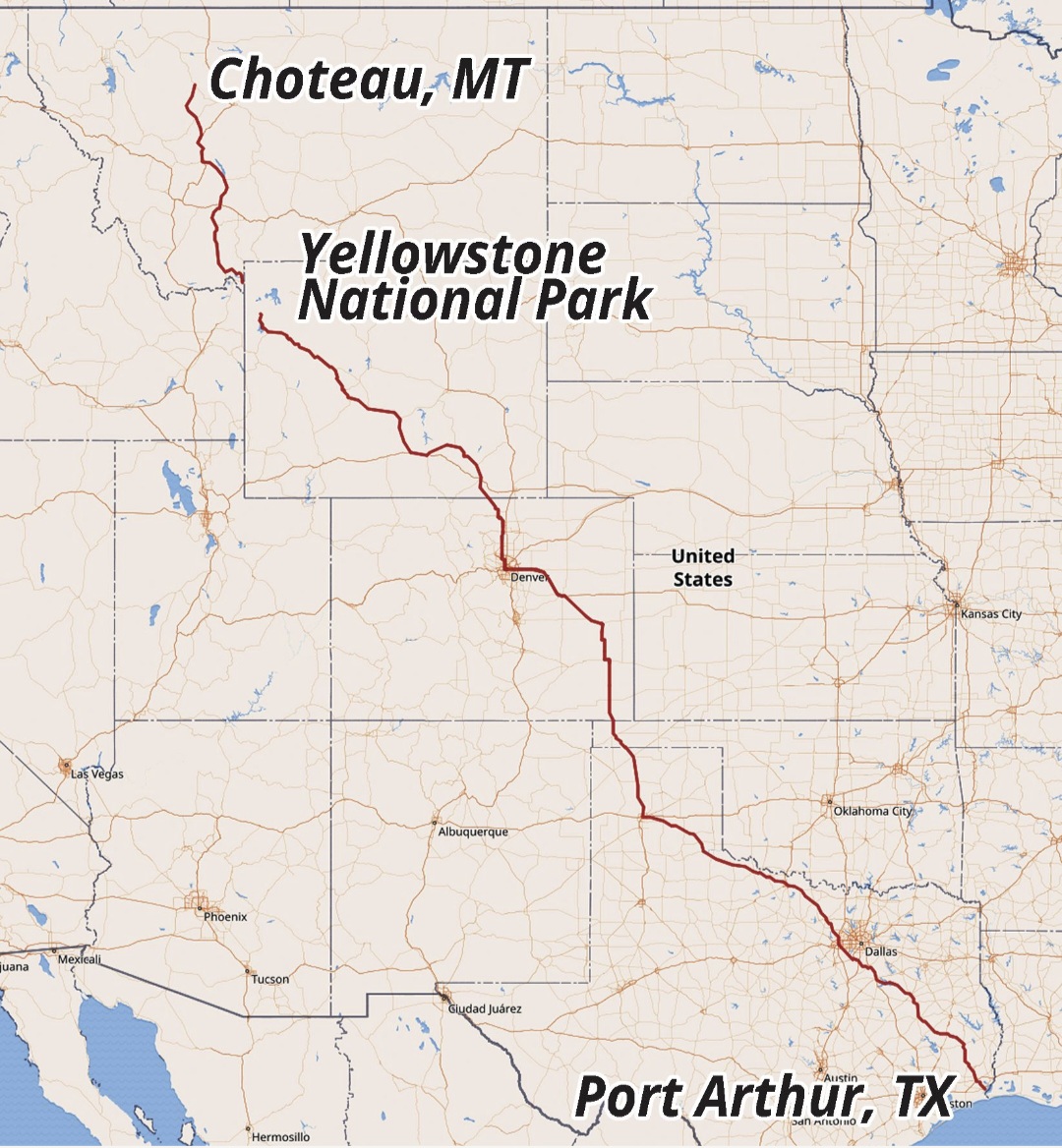
Article Published: // Volume: Edition: There's been a lot of noise lately about the proposed I-47 Interstate Highway. Last May Senators John Cornyn (R-TX) and Cynthia Lummis (R-WY) introduced Senate bill 4484, the "I-47 Future Interstate Act." That bill proposes to convert State Highway 287 (the route shown in the map from Texas to Montana and broken in two by Yellowstone National Park) into an Interstate Highway. At this time the bill has no funding for the project.
The primary advantage of this proposed interstate highway is it would be one of the rare diagonal highways in the U.S. It would inevitably become and important and well-used freight corridor from the Gulf ports through America's breadbasket to the Pacific Northwest, basically following the Old West cattle drive trails.
The two significant disadvantages are that there are already a considerable number of interstate highways along most of the route and it would require building a massive highway system through the middle of Yellowstone National Park — about which everyone regardless of political alignment should scream a united and resounding "No!"
But let's assume the proposed I-47 gets political traction and necessary funding. It's philosophically difficult to say no to expanding our nation's transportation infrastructure (I'm a huge advocate of passenger rail through Townsend, after all). It would support a great many well-paying jobs and support economic development along its length. But what would that mean to the sleepy city of Townsend?
I've believed for many years that the day will come when a major road bypass must happen around Townsend. I remember years ago ex-county commissioner Laura Obert explaining that she'd been told by the then director of the Montana Department of Transportation (MDT) that a bypass would never happen. But that was before substantial increases in traffic on both highways MT-287 and MT-12 and before the four-lane expansion plans for MT-287 began construction — plans that are scheduled to be complete everywhere but Townsend by 2030. It's not hard to look at the intersection of Front Street and Broadway right now and not know something's going to give way.
And all that was before I-47 was proposed, which would turn the future four-lane MT-287 into a four-lane divided controlled-access highway with interstate-grade setbacks.
Most people believe bypass roads kill towns. It's more accurate to say that unplanned bypass roads kill towns. Planned bypass roads contribute substantially to city development and economic growth. Why is it important to plan? Because I don't believe the idea is "if it happens," I believe it's "when it happens," and we should be thinking about how to protect our lifestyle while taking advantage of that inevitability.
I perceive five possible routes for a bypass and some of them really would kill the town.
1. The River Road route: a bypass is created from MT-285 at Toston more-or-less along River Road to reconnect with MT-287 somewhere north of Indian Creek Road. Advantage: no new bridges, which are very expensive. Disadvantage: traffic on increasingly popular MT-12 still winds through the middle of Townsend and this route ploughs through the middle of some of the most fertile farmland in the valley. Consequence to Townsend: 99% of the north-south traffic won't know Townsend exists. That's a positive to some of us, but it's disastrous to our local businesses.
2. The West Railroad route: a bypass is created diverging north of the Missouri River bridge near Toston and runs along the west side of the railroad tracks reconnecting with MT-287 either before or after the northern bridge over the Missouri. Advantage: it misses most of the farmland. Disadvantage: it'll require building an expensive overpass to cross the railroad tracks. Consequence to Townsend: almost as bad as route #1 (but at least people could see the city this time). Worse, the likely unavoidable temptation to route MT-12 traffic onto it via Railroad Avenue will be hugely disruptive to the city. (Can you imagine the clover-leaf or similar access needed in the Railroad Avenue floodplain to do that for I-47?)
3. The Front Street route: I don't consider routes 1 or 2 to be realistic, but this route is possible for the four-lane expansion of MT-287. I honestly don't think the State of Montana has the clout to convince BNSF railroad to give up any space on the west side of Front Street. That means converting three lanes worth of the east side of the road into a new MT-287. The advantage is all that traffic could visit local businesses. The disadvantage is that most of the parking lots and buildings along the east side of Front Street would be destroyed (and the MT-12 traffic is still a problem). Consequence to Townsend: congestion the likes of which we can't imagine today. If you stare at a map and think about this route, you'll likely come to the same conclusion I have: it won't happen. (And if I-47 gains any traction I believe this route isn't possible.)
4. The Eastern route: Starting a bit south of the Cenex gas station, this route wraps east around The Church of Jesus Christ of Latter-day Saints meetinghouse and back down a little north of Top Gun Auto Body. It requires widening the existing Missouri River bridge north of Townsend to four lanes (a divided four lanes for the Interstate). Advantage: Townsend can plan for city expansion on both the east and west sides of the bypass and MT-12 traffic is left outside the city. Disadvantage: though the least amount of affected farmland, some is still consumed by the road and city expansion. Consequences to Townsend: we have some control over city growth and we experience economic growth.
5. The Alternative Eastern route: Once again starting south of the Cenex gas station and wrapping up over the LDS Church, but after that it continues north passing either east or west around the Canton Lane mobile home park to a newly constructed bridge over the Missouri, thereafter merging again with MT-287 somewhere south of Sidewinder Road. The advantages and consequences to Townsend are the same as route #4 plus added growth space for the city and the county. The disadvantage is routing a large road through the Canyon Ferry Wildlife Management Area.
I could suggest a sixth solution: a raised highway along Front Street similar to what exists alongside Wallace, ID. It would be expensive, remarkably ugly, and isn't necessary due to the available land around Townsend, so I discount it.
I expect the average person reading this is now staring at the page in abject horror. The changes and their possible affect on our community are large. But the truth about cities is that they either grow or they stagnate and die. Townsend is filled with 50 –100+ year old buildings (and attendant infrastructure) that require economic growth to repair and replace them. But I'm a strong advocate that with planning, our small-town lifestyle can be protected and preserved. It's worth thinking about.
I have not been contacted by MDT and have no factual insight into the future plans for state highways or federal interstate highways. I'm presenting these ideas based on common sense and the need for public involvement. As always, these opinions are mine alone and do not reflect the opinions of the city council or the policies of the city of Townsend. I would love to hear your views on the topic! You can reach me via email at CouncilmanHowick@TownsendMontana.net.
JB Howick City Council Ward I
Article Images
Click on Image Thumbnail(s) to view fullsize image
PhotoCredit: Courtesy Of Wiki Commons
Image 1 Caption: Proposed I-47 route