Weed of the Month: Shepherd’s Purse
 | Author:
Allison Kosto, MSU Broadwater County Extension Agent
MSU Broadwater County Extension Agent |
Article Published: 04/03/2026 Volume: 4 Edition: 39Weed of the Month: Shepherd’s Purse
Allison Kosto
MSU Broadwater County Extension Agent
A rather distinctive plant, at least at maturity, Shepherd’s Purse can be troublesome in certain situations. It’s in the mustard family, so it is related to many other obnoxious weeds, including yellow alyssum, tumble mustard, flixweed, whitetop and dyer’s woad.
Description & Habitat
Native to Eurasia, Shepherd’s Purse was introduced to the United States before the 1700s and can now be found throughout North America, including Montana. It can be found along roadsides, disturbed areas, cropland, weedy pastures and the edges of lawns and landscape beds.
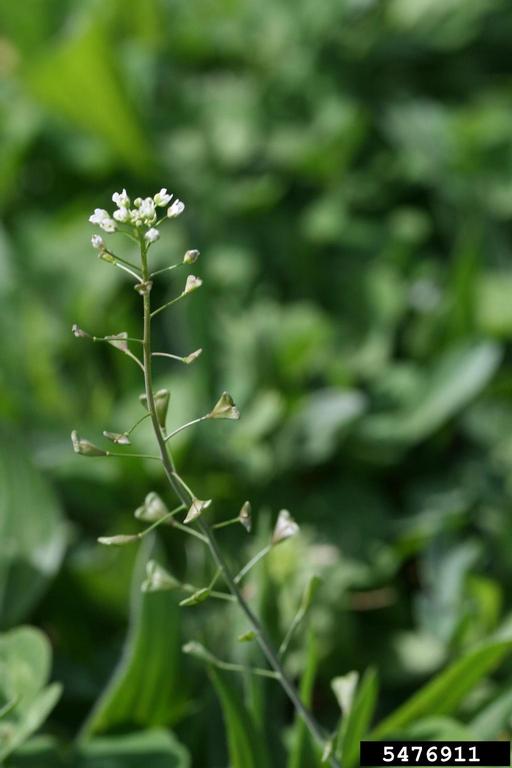
Shepherd’s Purse is a winter annual which means seeds germinate in late summer and early fall and produce a rosette in the fall. Leaves are deeply lobed, similar to a dandelion. The next year, it will produce a slender stem with few, if any, branches. It can be up to 20 inches fall. Most of the leaves are at the base of the plant. Small white flowers with four petals grow at the tips of the branches. These develop into a flat purse-like seed pod that are shaped like a heart. It is sometimes confused with pennycress which has oval seedpods.
Shepherd’s Purse is known to colonize on disturbed ground and prevent native or desired species from establishing. However, it is usually not very competitive so typically it will not persist for longer than two to five years in most cases after perennial plants are established. Seeds can persist in the soil for 35 years so plants can quickly reappear following a disturbance.
Management
Prevention is key with Shepherd’s Purse. It will not establish without open or disturbed soil. Research has also shown that intensive grazing can also increase densities of Shepherd’s purse. Maintaining healthy vegetation is key to preventing establishment.
As an annual plant, the most effective way to control Shepherd’s Purse is by controlling seed production. They can be done by pulling, digging, tilling or mowing before flowering or in the fall during the rosette stage. Livestock will graze Shepherd’s Purse, but grazing too intensely will only make the situation worse.
Herbicides can also be effective. Fall or spring applications are the most successful. Most commonly used chemicals include 2,4-D, Banvel, Cimarron, MCPP, Roundup and Weedmaster. Pre-emergent herbicides may also be an option in some situations but will need to be reapplied throughout the season. Always read and follow the entire label when applying herbicide. Common chemical names are used for clarity but does not imply endorsement of a product or brand.
For assistance on weed identification and management, contact the MSU Extension Office in Broadwater County at 406-266-9242.
Article Images
Click on Image Thumbnail(s) to view fullsize image
PhotoCredit: Chris Evans, University of Illinois, Bugwood.org
Image 1 Caption: Shepherd's Purse
Chris Evans, University of Illinois, Bugwood.org