Majority of Montanans favor legalized corner-crossing
 | Author:
Amanda Eggert, Montana Free Press
Montana Free Press |
A series of Wyoming court rulings have put a national spotlight on the public access created by checkerboard land ownership.
This article was originally published in the Montana Free Press and is published here courtesy of the Montana Free Press.
https://montanafreepress.org/2026/03/05/poll-majority-of-montanans-favor-legalized-corner-crossing/?utm_medium=email&utm_campaign=Newspack%20Newsletter%20%28262978%29&utm_source=2&utm_source=ActiveCampaign&utm_medium=email&utm_content=Montanans%20%E2%9D%A4%EF%B8%8F%20corner%20crossing&utm_campaign=Newspack%20Newsletter%20%28262978%29
A strong majority of Montanans support making corner-crossing explicitly legal, according to a Montana Free Press-Eagleton poll.
Corner-crossing is the act of stepping from adjoining corners of public land where alternating sections of public and private land exist in a checkerboard pattern. While the practice has been the subject of a high-profile court fight in Wyoming, there is no clear statute on its legality — or illegality — in Montana law.
In the absence of an unambiguous statute or Montana-specific case law, some Montanans argue the practice is a lawful way to access public land, while others maintain that corner-crossing amounts to trespassing.
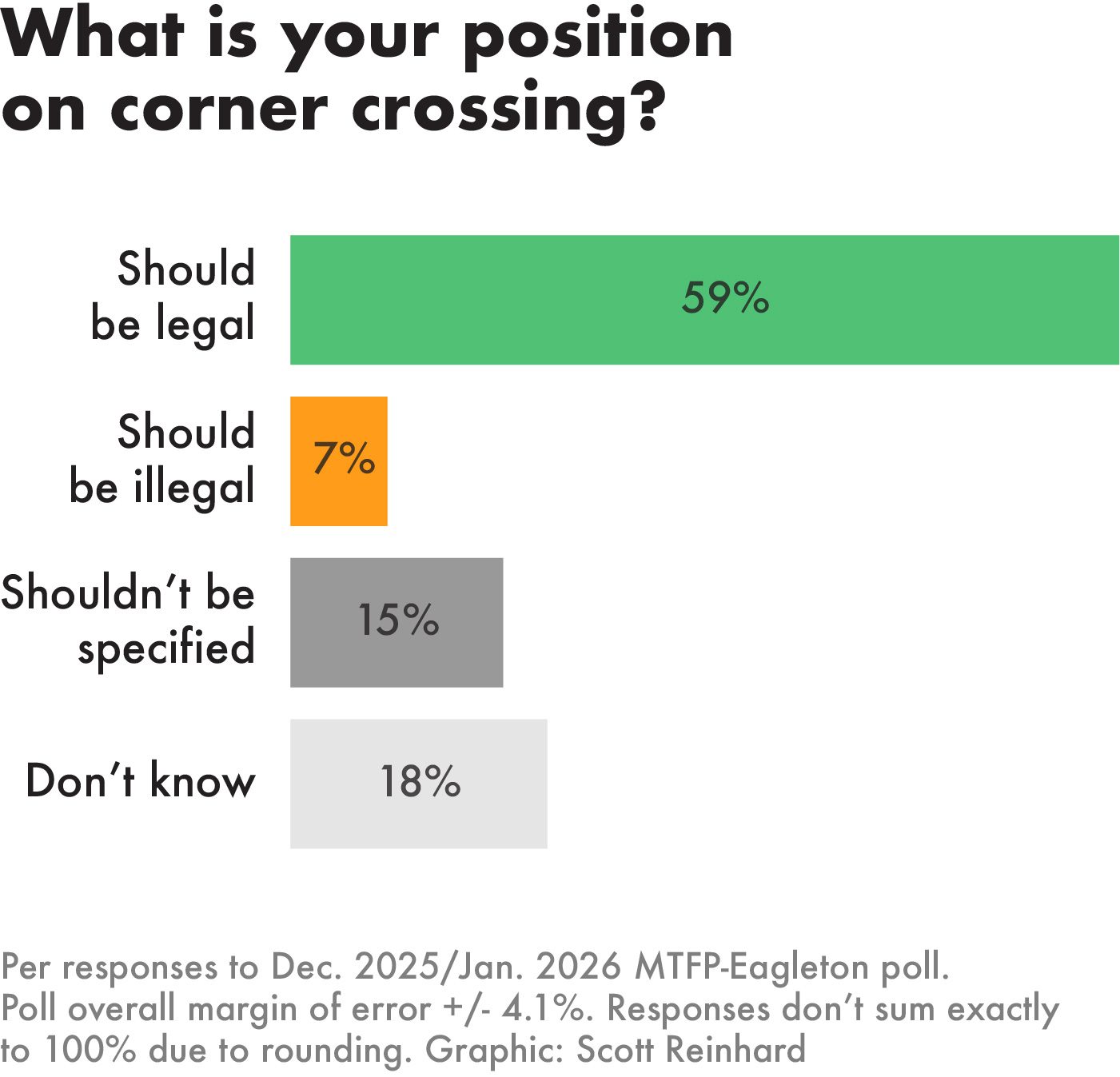
Nearly 60% of respondents to the MTFP-Eagleton poll agreed with the statement that corner-crossing “should be legal,” as compared to 7% who said it “should be illegal.” Another 15% said that policymakers shouldn’t pass laws “making it explicitly legal or illegal,” a position that maintains the ambiguous status quo. Nearly a fifth of respondents, 18%, said they “don’t know” in response to the question.
Pollsters found that the majority support for legalized corner-crossing spanned the political spectrum, but was strongest among self-described independents (65%) and Democrats (63%). For comparison, 53% of Republicans said corner-crossing should be legal.
For several years, Montana Fish, Wildlife and Parks has maintained that corner-crossing is not legal in Montana. The agency has directed wardens investigating trespassing claims to pass citations to county attorneys, who may or may not pursue charges against the person in question.
A 2022 analysis by OnX, a smartphone mapping company, found that Montana has nearly 900,000 acres of “corner-locked” land. Most of that checkerboard land is a legacy of the century-and-a-half-old decision Congress made to boost railroad expansion by granting railroad companies every other square mile along new rail lines.
The question of whether corner-crossing is an act of trespassing came to a head in Wyoming in 2022, when pharmaceutical executive Fred Eshelman pressed civil and criminal trespass charges against four corner-crossing hunters from Missouri who came to the state to hunt on Bureau of Land Management holdings near Elk Mountain, where Eshelman owns a 22,000-acre ranch.
After a lengthy court fight, none of the charges stuck, with the 10th Circuit Court of Appeals’ ruling that “the hunters could corner-cross as long as they did not physically touch” Eshelman’s land. The ruling technically applies only to states in that circuit: Wyoming, Colorado, New Mexico, Nebraska, Utah, Kansas and Oklahoma.
Since Montana is in a different appellate circuit, the ruling isn’t binding law here, although two groups in Montana — United Property Owners of Montana and the Montana Stockgrowers Association — filed briefs in support of Eshelman. Montana lawmakers in 2013 debated a bill to make the practice explicitly legal and another in 2017 to make it explicitly illegal. Neither of them passed.
There is at least one example in Montana of a corner-crossing hunter receiving misdemeanor charges after hunting on checkerboard land, although that case was different from the Wyoming case given that the corners weren’t perfectly aligned. In 2019, Paradise Valley resident Cody Cherry was cited for failure to obtain landowner permission to hunt. Due to a surveying quirk, a private ranch owned the 80-foot swath of land between the two corners of public land that Cherry attempted to connect on horseback.
Article Images
Click on Image Thumbnail(s) to view fullsize image
PhotoCredit: Montana Free Press and Eagleton (Rutgers University)
Image 1 Caption: Poll Results
Image 2 Caption: Logo
_30.png)


