Weed of the Month: Common Buckthorn
 | Author:
Allison Kosto, MSU Broadwater County Extension Agent
MSU Broadwater County Extension Agent |
Article Published: 02/06/2026 Volume: 4 Edition: 31Weed of the Month: Common Buckthorn
Allison Kosto
MSU Broadwater County Extension Agent
In the fall of 2025, a vigilant landowner brought a sample into the Extension Office that was quickly confirmed as Common Buckthorn. Common Buckthorn is a Montana noxious weed that was previously not identified in Broadwater County. This led to a chain reaction and the local Weed District has since discovered several thriving populations of Buckthorn in the county, including within the City of Townsend and on the backside of the lake. This is a very important weed to watch for in the upcoming year.
Description & Habitat
Native to Europe and Northwest Asia, Common Buckthorn was introduced to North America in the 1700s for medicinal purposes. It became naturalized in some areas in the 1800s due to extensive use in hedges. It has now been found in most Montana counties. It prefers moist soil but is highly adaptable. It can be found in forests, fence rows, pastures, fields and roadsides.
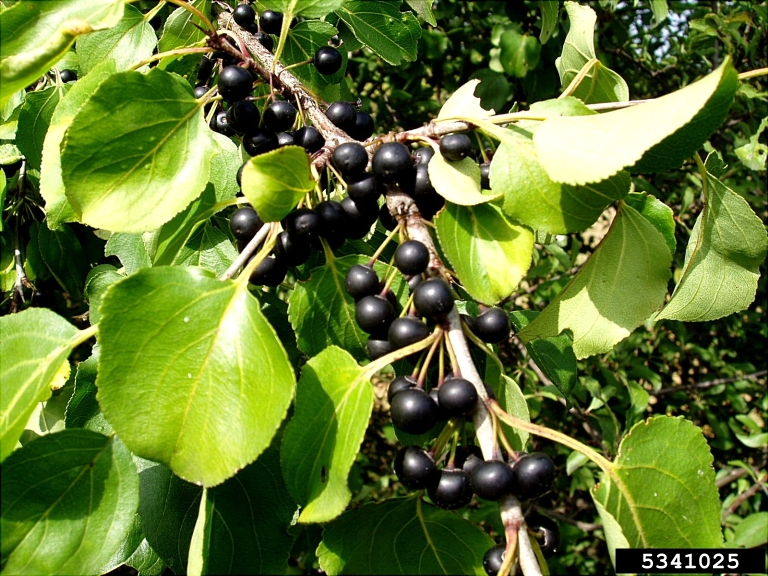
Common buckthorn is considered a large shrub or small tree and can grow 6 to 25 feet tall. The bark is brown to gray, while the inner bark has a distinctive orange or yellow color. You can expose the inner bark by scraping the bark with a knife, key or fingernail. Another key identifying feature is that the tips of the twigs have sharp thorns. Leaves are oval, glossy, dark green with finely toothed edges. Leaves stay green late into the fall, often beyond most native woody plants. Common buckthorn is dioecious, which means there are separate male and female plants. Only the female plants produce berries, which are purplish-black berry-like fruits that are about one-quarter inch in diameter. It is often confused with chokecherry, but the berries of Common Buckthorn are slightly bigger.
The plant spreads by seed, often by birds or small mammals that eat the fruit. Common buckthorn can outcompete native vegetation to form dense thickets. It can impact wildlife presence and habitat use. It is an alternative host for the crown rust fungus of oats, which can reduce oat yield and quality. Eating the bark, leaves and berries can cause nausea, vomiting and diarrhea.
Management
Early dedication is key to keeping it from spreading further. Fruit-bearing trees are much easier to identify. Fall is an ideal time for monitoring, because of the visible foliage and black fruit.
Seedlings can be controlled by hand-pulling or mowing. Occasional burning will not eliminate common buckthorn. Repeated burns may be effective but are often not practical. There are currently no biological control agents for Common Buckthorn. Goats have been known to graze young plants.
Herbicides can be effective and should be done in combination with stump cutting for larger trees (larger than 6 inches in diameter). Cutting without herbicide will result in the tree sending out new shoots. Apply the herbicide within 15 minutes of cutting the tree. Late fall applications are recommended to reduce injury to desirable vegetation. Most common herbicides include Milestone, Garlon, Triclopyr, Roundup or a combination. Trees may suffer even with herbicide treatment and may need to be retreated. Any plants that are removed should be piled and burned to reduce seed spread. Always read and follow the entire label when applying herbicides. Common chemical names are used for clarity, but do not imply endorsement of a product or brand.
For assistance on weed identification and control, contact the MSU Extension Office in Broadwater County at 406-266-9242 or the Broadwater County Weed District at 406-266-9243.
Article Images
Click on Image Thumbnail(s) to view fullsize image
PhotoCredit: Jan Samanek, Phytosanitary Administration, Bugwood.org
Image 1 Caption: Buckhorn Berries
Photo Credit: Jan Samanek, Phytosanitary Administration, Bugwood.org