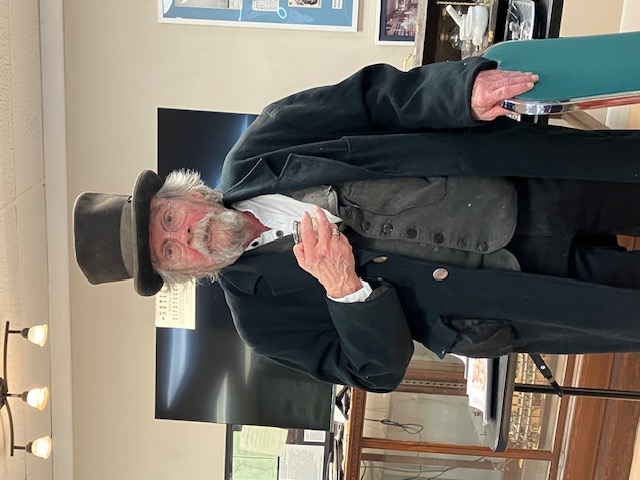
Jerome Glick, MD, 1850's Bannack and Virginia City Doctor
Author: Nancy Marks, MT43News
Article Published: 01/23/2026 Volume: 4 Edition: 29Nancy Marks, MT43 News Reporter
If you were a gold miner in Virginia City in the 1850’s with a bad back, you would undoubtedly be treated by the infamous Jerome Glick, MD. The Lewis & Clark Historical Society treated an audience to John Barrow’s re-enactment of Dr. Glick at the Museum’s location in the Steamboat Block in Helena a week ago.
Barrows, an avid historian who has performed the re-enactment for 12 years, was dressed in a disheveled black suit, complete with a top hat. He told how Dr. Glick studied to be a surgeon under the watchful hands of his teacher at McDowell College in St. Louis, Missouri, where he dissected human cadavers, his class “resurrected” from a nearby cemetery. Glick received his medical certificate after two years, then attended dental school.
Glick served as a contract surgeon in the US Army prior to the Civil War, but was imprisoned in New Mexico because he was a Southern sympathizer. He escaped and headed north to Bannack in July of 1860, where he plied his trade to the miners. He worked with Dr. Levick Erasmus, who spent his time panning for gold, while Glick “panned” the miners, treating their accidents and often lead poisoning.
His claim to notoriety arrived when he cut off the arm of the also infamous Henry Plummer, head of Bannack and Virginia road agents. He had treated Plummer for a gunshot wound in his arm. Glick could not remove the bullet, but sat with Plummer until he recovered. When Plummer was fatally shot and put to rest, Dr. Glick opened the grave and sawed off Plummer’s arm, mostly to ascertain where the bullet lay.
Barrows has collected a full set of 1850’s surgeon’s tools, which he described and pretended to perform surgeries on members of the audience. For the man with the back pain, Glick used a catlin(16-inch scalpel) to make an incision, where he bled the patient, then prescribed a good liniment to put on the area and laudanum (capsaicin, whiskey and licorice) for the pain.
Should the patient complain of frostbite, which was rampant during the bitter winter of 1874, Dr. Glick performed amputation of the affected limb with an assortment of huge filet knives and a steel saw. He applied a black tourniquet, then chloroformed the patient. The chloroform anesthetic did not put the patient out, but numbed the pain. Following the amputation, Glick treated the wound with Oil of Vitriol (sulphuric acid) and packed the wound with maggots to head off infection.
According to Barrow’s extensive research, doctors of the time were faced with trying to cure small children and adults who had contracted diphtheria, a disease that forms a fibrous growth in the throat. Treatment consisted of applying a coat of strychnine, which eventually killed the patients anyway. Most doctors encouraged parents of children to “let the disease run its course.” Thousands died of diphtheria, measles and smallpox.
Barrows credited Dr. Glick with successfully treating worms, a common ailment of the time with bicarbonate of soda and 15 ground pumpkin seeds to be ingested by the patient. In addition, he prescribed Rushes pills, used by Lewis and Clark’s crew. The pills contained mercury, which caused violent diarrhea to flush out the worms. Glick kept an 85-foot worm in alcohol he removed from a patient.
Barrows said Dr. Glick died in 1880 and is buried in the Benton Avenue Cemetery in Helena.
Barrows served as publisher of the Dillon Tribune for 16 years and the Ravalli Republic in Hamilton. He ended his newspaper career as Executive Director of the Montana Newspaper Association. After his retirement, he spearheaded moving the East Helena train depot and seeing through its restoration. The train depot building now stands on East Helena City Building lot on Main Street in Helena. He is an active member of the Lewis and Clark County Historical Society.
Article Images
Click on Image Thumbnail(s) to view fullsize image
PhotoCredit: Nancy Marks, MT43 News Photographer
Image 1 Caption: Dr. Jerome Glick (played by John Barrows) holds his cupping utensil, which was commonly used in mid-1800's to bleed patients or administer anesthesia, among other uses. Barrows has re-enacted the well-known early Montana doctor for 12 years.
Nancy Marks, MT43 News Photographer